| |
Contact Information:
Yale School of Management
135 Prospect St., Box 208200
New Haven, CT 06520-8200
(203) 432-6049 (office)
(203) 432-6974 (fax)
keith.chen@yale.edu |
Office hours: Thursdays, 9:30 to 11:00
Assistant:
Mary Ellen Nichols
(203) 432-3955 (office)
maryellen.nichols@yale.edu |
|
|
|
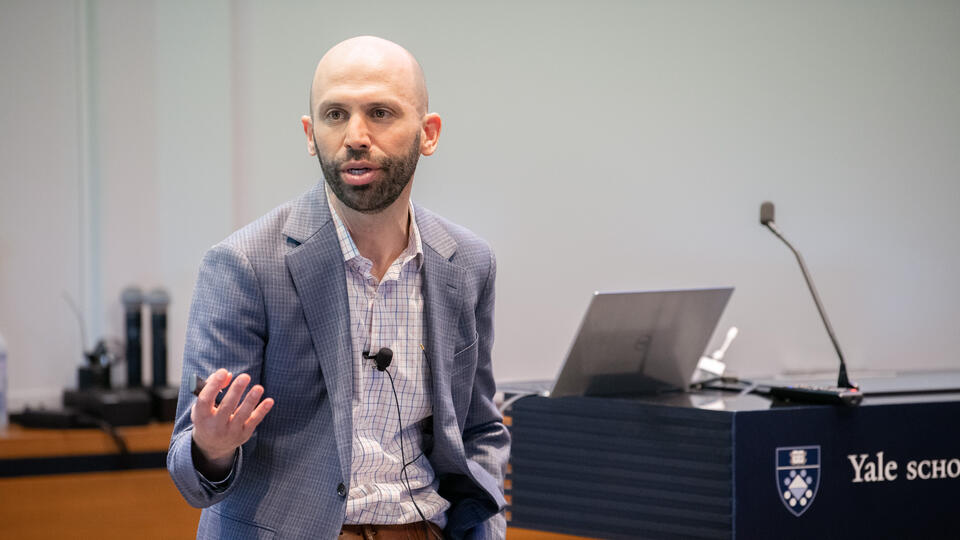
Professor Chen's research blurs
traditional boundaries in both subject and methodology,
bringing unorthodox
tools to bear on problems at the intersection of Economics,
Psychology, and Biology.
In a recent project he measured what ex-prisoners lives would
have looked like had prison conditions been more or less
harsh. In another project he demonstrates the ability of
Tamarin Monkeys to master complex repeated food-exchange
games, displaying a game-theoretic
acumen previously thought unique to humans. Most recently
Professor Chen has shown that when allowed to make
purchasing decisions, Capuchin Monkeys display many of
the hallmark biases of human behavior, suggesting that
some of our most fundamental biases are evolutionarily
ancient. This year Professor Chen teaches Negotiating
Strategy, and Behavioral
Economics.
Research Interests:
Primary Fields:
Behavioral Economics, and Applied Microeconomics.
Secondary Fields:
The Microfoundations of Preferences and Biases.
Teaching:
Bargaining & Negotiations, Behavioral Economics,
and Microeconomic Theory.
Most
Recent Working Paper:
Rationalization and Cognitive Dissonance: Do Choices Affect or Reflect Preferences?
This draft: January, 2008
You can read about the working paper in a recent article:
|
| |
And Behind Door No. 1, a Fatal Flaw
The New York Times, April 8th, 2008
Synopsis:
The Monty Hall Problem has struck again, and this time it's not merely embarrassing mathematicians. If the calculations of a Yale economist are correct, there’s a sneaky logical fallacy in some of the most famous experiments in psychology... |
Most
Recent Published Papers:
Modeling a Presidential Prediction Market
Joint with Jonathan E. Ingersoll and Edward H. Kaplan
Forthcoming, Management Science, 2008
The Taste for Leisure, Career Choice, and the Returns to Education
Joint with Judith Chevalier
Forthcoming, Economic Letters, 2008
Do Harsher Prison Conditions Reduce Recidivism? A Discontinuity-Based Approach
Joint with Jesse Shapiro
American Law and Economic Review, 2007
|
|